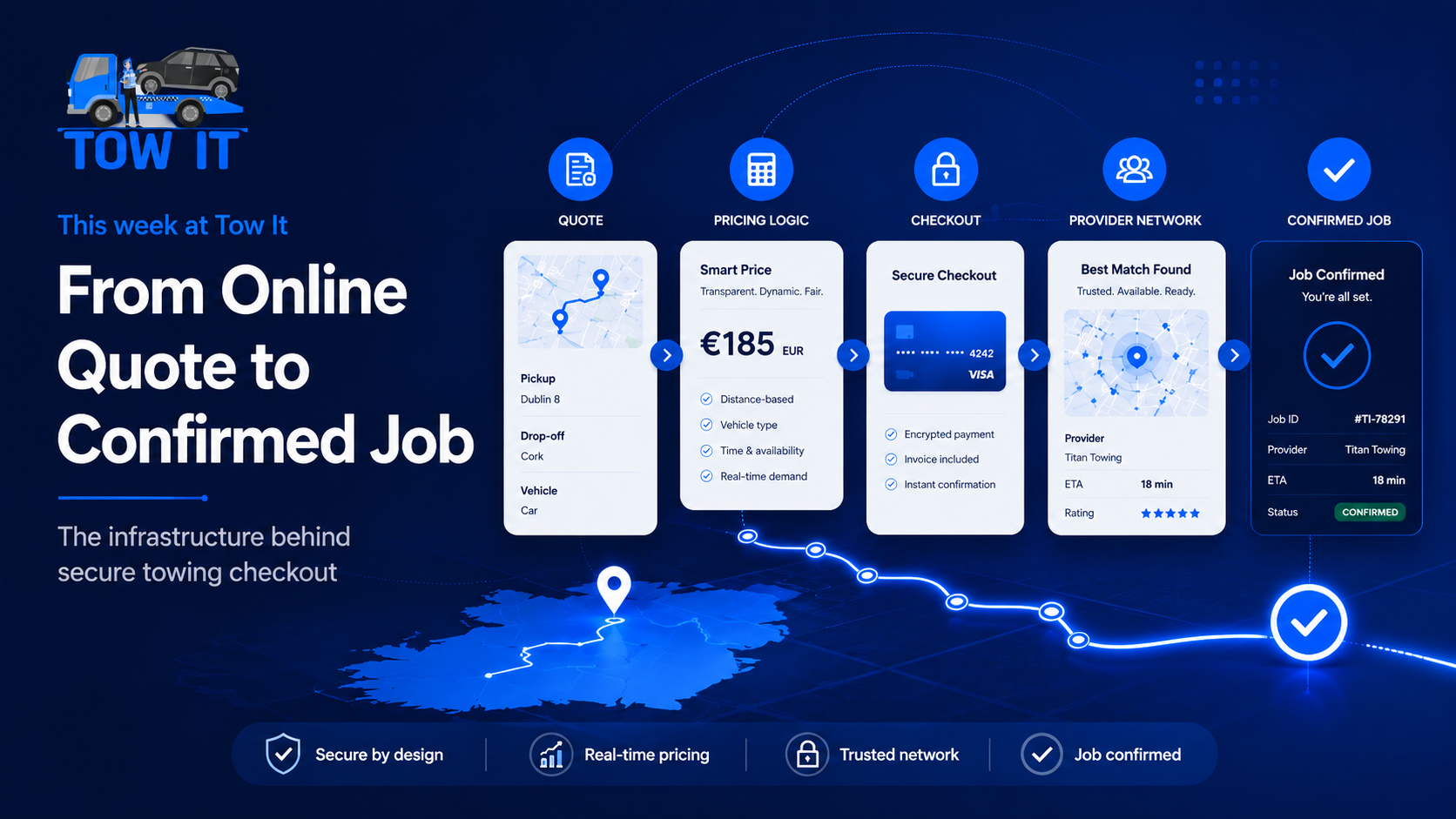
Getting a tow online should feel simple. A driver enters a pickup location, adds a destination, sees a price and confirms the service.
But vehicle recovery is not like buying a product online. A tow is not a fixed item on a shelf. It is a real-world operation that needs to be understood before it can be priced, confirmed and completed.
That is the topic we are covering this week: how Tow It turns an online quote into a confirmed job.
The weekly story
Problem
Towing is hard to confirm online
The job is not always simple to define before the operator understands the real conditions.
Therefore
Tow It structures the job first
Route, vehicle details, access, complexity and qualification are brought into one flow.
Result
Checkout becomes operational
When price, job data and provider capacity connect, checkout becomes a confirmed job.
A tow is not just a route
At first, towing looks like a distance problem. A vehicle needs to move from point A to point B, so it seems logical to think the price should be based mostly on mileage or route time.
But two jobs with the same distance can be completely different.
A car parked on a clear public road is not the same as a vehicle inside a tight underground car park. A car with keys and rolling wheels is not the same as one with a locked transmission, missing keys, collision damage or limited access around it.
Route
Where does it need to go?
Context
How difficult is the job?
Capacity
Can a provider execute it?
A simple transport job may be straightforward. A recovery job may require the operator to understand whether the vehicle can be loaded safely, how much space is available and whether the situation needs manual review before a price can be trusted.
Key point: before checkout can work, the job has to be defined.
This is why towing has traditionally depended on phone calls, WhatsApp messages, photos, rough estimates and manual follow-up. The operator needs more information before committing. The driver wants to know the price before booking. The platform needs to understand whether the job is simple enough to confirm online or whether it needs manual verification.
Where online checkout usually breaks
In many online services, checkout is the easy part. The product is already defined. The price is already known. The seller knows what is being delivered.
In towing, the difficult part happens before payment.
If a driver sees a price but does not understand what it includes, they hesitate. If the operator receives incomplete details, the job may become risky or unprofitable. If the system asks for payment before understanding the service, the checkout feels premature.
Users start the request, but the quote still needs to feel trustworthy enough for them to continue.
Operators need complete details, because a vague request can become a difficult or unprofitable job.
The system needs qualification logic, because not every request should be pushed directly into checkout.
The solution starts before payment
Tow It built checkout around service structure, not just payment technology.
That means the system does not only ask where the vehicle is and where it needs to go. It also collects the operational details that can change the nature of the job.
Location context
Public road, private property, underground car park or restricted access.
Vehicle condition
Flat tyre, dead battery, collision damage, missing keys or locked wheels.
Handling difficulty
Open space, tight space, blocked access or limited loading conditions.
Qualification
Some jobs can go to checkout. Others need manual verification first.
These details matter because they affect the effort, risk and handling required for the job. They also help the system decide whether the request is ready for checkout or should be reviewed manually.
Technology turns knowledge into a repeatable system
Tow It is not only technology, and it is not only operational knowledge. The value comes from combining both.
Towing knowledge tells us what matters: route, access, vehicle condition, timing, complexity and execution capacity. Technology allows those factors to be applied consistently across requests.
The Tow It operating flow
01
Pricing engine
Calculates the base price from route and service logic.
02
Complexity inputs
Add vehicle condition, access and handling difficulty.
03
Qualification logic
Identifies whether checkout is suitable or review is needed.
04
Checkout flow
Turns a valid quote into a confirmed request.
05
Provider flow
Connects the job to recovery operators who can execute the work.
This is what makes checkout credible. Not the payment button by itself, but the system behind it.
A driver can trust checkout when the price feels connected to the real service. An operator can trust a digital job when the details are complete enough to act on. And the platform can scale only if it avoids treating every vehicle movement as the same kind of job.
Provider capacity makes checkout real
Even strong pricing is not enough on its own.
A towing job can be priced correctly and still fail if there is no provider available to complete it. This is one of the key differences between vehicle recovery and many other online services.
A confirmed request is only meaningful if it can be passed to a real recovery operator or vehicle transport provider capable of doing the job.
What provider capacity changes
For drivers
The online request is connected to real execution capacity.
For providers
The job arrives with clearer details and less back-and-forth.
For businesses
Vehicle movement becomes more traceable and easier to coordinate.
That is why Tow It connects structured demand with a provider network. The system is not only helping drivers request towing online. It is also helping turn those requests into clearer jobs for tow truck drivers and recovery operators.
From quote to confirmed job
The real shift Tow It is building is simple: a towing request should not stay as a loose message.
It should become a structured job.
That means the job has a route, vehicle details, context, price, payment status, provider path and operational record.
What we will cover this week
Part 1
The problem
Why towing is hard to price and confirm online.
Part 2
The system
Why secure checkout depends on operational pricing and structured service data.
Part 3
The execution layer
Why provider capacity turns an online quote into a confirmed job.
Because in towing, the payment is not the hard part.
The hard part is turning a messy, uncertain situation into something clear enough to price, trusted enough to confirm and connected enough to execute.
That is what Tow It is building.